Small Extra Payments = Big Mortgage Wins

Mortgage Tips Jag Dhamrait 18 Jun

Model house beside three stacks of coins. Text reads: “Small Extra Payments. Big Mortgage Wins.”

Extra mortgage payments can help reduce interest and shorten your amortization, subject to your mortgage terms.


Small extra mortgage payments can make a big difference over time by helping reduce interest and shorten your amortization.

Having some extra cash on hand might give you some breathing room on rising gas and food prices, building an emergency fund, or even the ability to make a big purchase you’ve delayed. But – should you pay down your mortgage instead? If you’re considering paying down your mortgage, you’re in luck, because today we’re going to look at how a lump sum payment can transform your mortgage future.

Base Case Scenario

Here we’re going to look at a mortgage with a $500,000 balance at a rate of 4.99% and a 25-year amortization. In this scenario, your monthly payment would be $2,905.18. If we fast forward 25 years to the end of that mortgage, having made no lump sum payments, you’ll have paid $371,554 in interest and a total of $871,554 in payments for your $500,000 mortgage. Although your rate will vary over the course of your mortgage, in this example we’re going to keep it consistent at 4.99%.

Payment Options

When we’re talking about paying down your mortgage early, there are three main ways you can do this. The first is to save a lump sum of cash, which you put down all at once, one time per a year (for example, on your mortgage anniversary). You don’t have to make this payment every year, but you likely have the option to put down a flexible amount of cash with upper and lower limits every year of your mortgage.

The second option is to round up your regular payments to a set amount. Again, there will be upper and lower limits on how much you can pre-pay, but you’ll likely be able to round up by a couple hundred dollars or to the nearest $100, for example.

The third option is to go with accelerated payments, which are normally offered weekly or bi-weekly. Here the lender will calculate the specific amount for you.

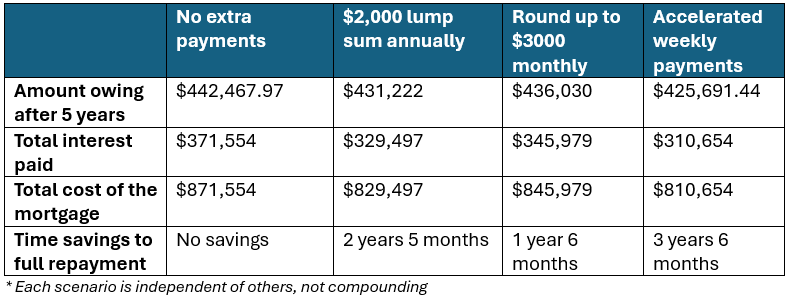
Each of these options will help you pay less in interest over the lifetime of your mortgage, with varying impact on the total amount of interest. Below is a chart showing how these three prepayment types can change your mortgage.


As you can see, even a small monthly increase in your payment can save you tens of thousands of dollars on your mortgage. The biggest impact you can make on your own financial future is to change your payment frequency – the more often you pay, the less interest you pay, and the sooner you pay off your mortgage in full! Even if you don’t have a new mortgage, you can start any of these strategies at any time.  Whenever you do start prepaying, you’ll start saving time and money over the rest of the term of your mortgage.

Be Aware: It’s important to consult your lender about what prepayment types and amounts allowed within your current mortgage. Many lenders set prepayment amounts as a percentage of your outstanding mortgage balance, although some lenders offer more unique options like doubling a payment.

If you want to run this scenario for your own mortgage, with whatever numbers you have, and different prepayment amounts, I’ve got great news. You can download my app and do it all – easily and for free – whenever you want. And if you have questions, you can DM or call me right in the app for help!

Let’s Talk About Your Mortgage Goals

Buying, renewing or refinancing? Let’s explore mortgage options that fit your goals and financial situation.

Jag Dhamrait
Mortgage Agent Level 2
Phone: 647-883-7790
Email: jag@jagdhamrait.com


Apply Now

Economic Insights from Dr. Sherry Cooper

Economic News Jag Dhamrait 3 Jun

Outlook for the Canadian Housing Market, 2026–2027

Canada’s housing market is set to undergo a period of slow recovery and structural adjustment in 2026 and 2027.


After several years marked by aggressive rate increases, deteriorating affordability, and uneven regional performance, the market is more likely to stabilize than to stage a dramatic rebound. Forecasts from the Canada Mortgage and Housing Corporation (CMHC), the Canadian Real Estate Association (CREA), and the major financial institutions broadly converge on the same picture: modest price growth, subdued sales activity, and continued supply shortages in key regions over the next two years.

Monetary policy is the central driver of this outlook. The Bank of Canada has lowered the overnight rate from its 5% peak—reached during the inflation-fighting cycle of 2022–2024—to 2.25% today, and the policy rate is expected to remain near current levels through most of 2026.

Market-determined interest rates, however, have moved in the opposite direction. Since the outbreak of the U.S.–Israel–Iran war nearly three months ago, oil prices have surged and inflation expectations have re-priced sharply higher, triggering a broad-based sell-off in government bonds and a meaningful back-up in longer-term yields. The result is a widening gap between the policy rate and the borrowing costs that households and businesses actually face.

Mortgage rates nonetheless sit well below their late-2023 highs, improving affordability at the margin and drawing some sidelined buyers back into the market. A return to the ultra-low borrowing costs that fuelled the pandemic-era boom is not in the cards. The Bank of Canada has been explicit that inflation risks remain elevated—particularly from global energy markets and ongoing geopolitical uncertainty—so rates are likely to hold around current levels through most of 2026 before gradually normalizing in 2027.

Economic growth is expected to remain weak this year, which will cap housing demand. CMHC forecasts Canadian GDP growth of just 0.7% in 2026, making it one of the weakest non-recessionary years in decades. Elevated household debt, soft labour market conditions, and slower income growth are weighing on consumer confidence, which has fallen to a record low. At the same time, reduced immigration targets and slower population growth are easing some of the demand pressures that intensified the housing crisis earlier in the decade.

Home prices are expected to rise only modestly over the next two years. CREA forecasts the national average price to increase roughly 1.5% in 2026 and less than 1% in 2027, leaving prices effectively flat in real terms. CMHC similarly anticipates only limited gains following the price declines recorded in 2025.

Taken together, the market is transitioning out of the speculative conditions of the pandemic era toward a more balanced environment. Buyers have become more price-sensitive, while sellers face stiffer competition from elevated inventory in many urban markets.

Regional divergence will remain one of the defining features of the Canadian market. Ontario and British Columbia are expected to underperform the rest of the country, as affordability remains severely stretched in both provinces. Toronto and Vancouver condominium markets look particularly vulnerable: investor demand has weakened, while developers face rising construction costs and slower pre-sales. CMHC expects housing starts in these markets to remain below historical averages through 2027.

Alberta and parts of Quebec, by contrast, are likely to outperform. Calgary and Edmonton continue to benefit from better affordability, strong interprovincial migration, and comparatively resilient economic growth driven by the energy sector. Quebec’s market has remained more stable thanks to lower average prices and a broader mix of housing types. Even these stronger regions, however, are expected to cool somewhat as national population growth slows and rental supply expands.

Housing supply remains the market’s central long-term challenge. Canada continues to build far fewer homes than are needed to restore affordability. CMHC estimates that the country requires roughly 430,000 to 480,000 new homes annually through 2035 to return affordability to 2019 levels. Yet housing starts are forecast to fall from approximately 259,000 units in 2025 to about 247,000 in 2026 and 223,000 in 2027. Developers are delaying projects in response to financing costs, weaker demand, labour shortages, and elevated construction costs. Condominium development is especially weak, while purpose-built rental construction remains the strongest area of activity.

The rental market is gradually moving back toward balance. A large pipeline of apartment completions in major cities is easing pressure on vacancy rates and slowing rent growth. Rents will remain high by historical standards, but the rapid increases recorded between 2021 and 2024 are expected to moderate. That easing should reduce the urgency for many would-be first-time buyers, a large share of whom have remained renters because ownership costs are still prohibitive.

Overall, the Canadian housing market in 2026 and 2027 is best characterized by a cautious recovery rather than a rapid expansion. Lower policy rates and gradually improving affordability should support a modest pick-up in sales activity, but economic uncertainty, geopolitically driven volatility in market rates, and persistent supply constraints will keep growth in check. Prices are likely to remain relatively stable nationally, with significant divergence between weaker high-cost markets and stronger affordable regions. Over the longer term, Canada’s housing affordability problem will remain unresolved unless construction activity rises substantially above current levels.