Small Extra Payments = Big Mortgage Wins

Mortgage Tips Jag Dhamrait 29 Jun

Young woman using smartphone while reviewing documents at home. Pay down your mortgage with small extra payments and prepayment strategies

Small extra mortgage payments can make a big difference over time by helping reduce interest and shorten your amortization.


Having some extra cash on hand might give you some breathing room on rising gas and food prices, building an emergency fund, or even the ability to make a big purchase you’ve delayed. But – should you pay down your mortgage instead? If you’re considering paying down your mortgage, you’re in luck, because today we’re going to look at how a lump sum payment can transform your mortgage future.

Base Case Scenario

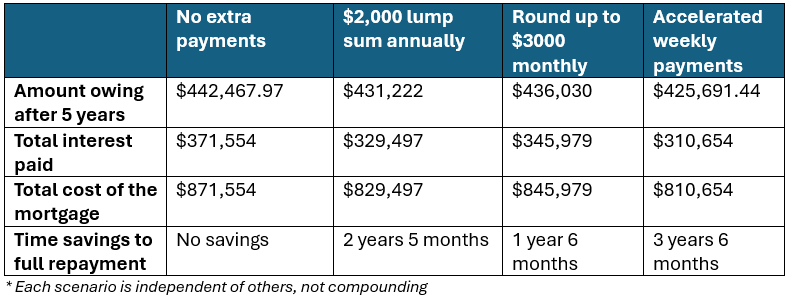
Here we’re going to look at a mortgage with a $500,000 balance at a rate of 4.99% and a 25-year amortization. In this scenario, your monthly payment would be $2,905.18. If we fast forward 25 years to the end of that mortgage, having made no lump sum payments, you’ll have paid $371,554 in interest and a total of $871,554 in payments for your $500,000 mortgage. Although your rate will vary over the course of your mortgage, in this example we’re going to keep it consistent at 4.99%.

Payment Options

When we’re talking about paying down your mortgage early, there are three main ways you can do this. The first is to save a lump sum of cash, which you put down all at once, one time per a year (for example, on your mortgage anniversary). You don’t have to make this payment every year, but you likely have the option to put down a flexible amount of cash with upper and lower limits every year of your mortgage.

The second option is to round up your regular payments to a set amount. Again, there will be upper and lower limits on how much you can pre-pay, but you’ll likely be able to round up by a couple hundred dollars or to the nearest $100, for example.

The third option is to go with accelerated payments, which are normally offered weekly or bi-weekly. Here the lender will calculate the specific amount for you.

Each of these options will help you pay less in interest over the lifetime of your mortgage, with varying impact on the total amount of interest. Below is a chart showing how these three prepayment types can change your mortgage.


As you can see, even a small monthly increase in your payment can save you tens of thousands of dollars on your mortgage. The biggest impact you can make on your own financial future is to change your payment frequency – the more often you pay, the less interest you pay, and the sooner you pay off your mortgage in full! Even if you don’t have a new mortgage, you can start any of these strategies at any time.  Whenever you do start prepaying, you’ll start saving time and money over the rest of the term of your mortgage.

Be Aware: It’s important to consult your lender about what prepayment types and amounts allowed within your current mortgage. Many lenders set prepayment amounts as a percentage of your outstanding mortgage balance, although some lenders offer more unique options like doubling a payment.

If you want to run this scenario for your own mortgage, with whatever numbers you have, and different prepayment amounts, I’ve got great news. You can download my app and do it all – easily and for free – whenever you want. And if you have questions, you can DM or call me right in the app for help!

Fraud Awareness: Essential Info for Today’s Digital World

Personal Finance Jag Dhamrait 1 Mar

Senior man on cell phone - Fraud awareness for phone scams and digital fraud

Fraud awareness starts with recognizing red flags in calls, emails, texts, and online messages.

March is fraud awareness month, a great reminder that no matter who you are, scams are lurking right around the corner (or in the next email, call or post!). 2026 will undoubtably throw more sneaky, compelling, and downright dastardly scams than ever. So, we’re going to look at how and why fraud scams work, spotlight the techniques scammers use, give you tips on how to recognize a scam, and teach you what you can do to protect yourself.

Why do scams work? 

Here are my 4 E’s of an effective scam:

  1. Ego: Some people think they are too smart to fall prey. Their overconfidence says they don’t need to be cautious and that exposes them to unnecessary risk.

  2. Evolution: Scams are diverse and sophisticated – it’s not a Nigerian Prince asking you to share his millions anymore! The constant changing and diversification of scams is fuelled by new technology, making it harder to spot a fake.

  3. Education: A lack of awareness means you’re a step behind a fraudster, and you’re unlikely to recognize the newest and greatest plots.

  4. Exposure: We’re online a LOT, constantly seeing fake ads, sharing our email addresses to get discount codes, commenting on social media posts – you name it. We constantly expose ourselves to predators.

Techniques Scammers Rely On

The first strategy scammers use is emotional manipulation. They’ll create uncomfortable feelings like fear or urgency to get you to act quickly. They’ll also go the sympathy and goodwill route to appeal to your good nature and empathetic side so you help them.

The second strategy scammers use is cognitive bias. It’s our predisposition to a certain mindset that would make you more willing to comply. A few examples:

  • Optimism Bias: You don’t automatically suspect a scam

  • Truth Bias: You assume people are telling the truth

  • Authority Bias: You trust and comply with authority figures (like police or government)

The third strategy scammers use is influence. They’ll compliment you or pretend to have similar likes so they build a relationship with you. They’ll act as experts or authorities so that you trust them. And, they’ll commit to it, starting slow and building over time and increasing their requests.

How Did Scammers Get So Good?

They practice. They aren’t afraid to fail. They don’t take no as an answer. And, perhaps most importantly, they embrace technology. It catches victims unaware and drastically improves their reach and persuasiveness. Here are their fanciest tools.

  1. AI: AI makes it easy for scammers to create professional-looking websites, social media content, online ads, fake photos, persuasive emails and texts, and so much more.

  2. The Dark Web: Scammers can buy nearly any data they want, plus fake identities, malware tools, stolen credit card numbers, ransomware, a fake escrow service or even hire hackers.

  3. Deepfakes: Fake videos that clone real people and real voices are easy to create with free or cheap specialized software. These fake videos can promote products, laud fake charities or causes needing donations, even endorse ponzi schemes and pump-and-dump investments.

  4. Spoofing software: Fraudsters can mimic legitimate phone numbers, emails, or websites and even trick you into thinking you’re dealing with a real person you know.

Red Flags 

Scammers aren’t just straight up asking for your SIN and banking info anymore. Here are some common themes to watch for:

  • Urgency, including limited time offers or requests to act now

  • Threats, like an account will be closed, you’ll be arrested, or a fine is forthcoming

  • Uncommon payment forms, like wanting gift cards, cryptocurrency, or Venmo transfers

  • Secrecy, warning you not to tell friends or family or alert law enforcement

  • Poor quality, like spelling errors, weird links, or other telltale signs AI has been hard at work

  • Reciprocity, as in you get hired but you pay for your own training, or you won a prize but you have to pay to receive it

How to Avoid Falling for Scams 

If you don’t want to be blindsided by a scam, the first step is to know that scams exist. Staying current on the latest schemes will go a long way. Be skeptical about almost everything online! Installing ScamShield, call blocking or anti-virus software can help prevent a scam artist from contacting you. Multi-factor authentication is a great way to stop scammers from accessing your online accounts.

If you get faced with a scam, take a step back and think about the legitimacy of the situation. Call a trusted friend or loved one and run the situation by them. Just hearing it out loud might make you come to your senses! Practice saying no. Disconnect from the situation and reach out to the company independently (like the CRA, bank, cell phone company or store) to confirm the request or offer is real. Finally, monitor your accounts for any unauthorized activity if you think you might have given away too much information.

Conclusion

If you’d like to learn more, the FCT fraud insights centre is a great place to start. Or, get your information in video form in Mastercard’s Anatomy of a Scam docuseries. Hopefully shining a spotlight on these tactics keeps your safety top of mind. Or as Bert and Gert would say, “Stay Alert, Stay Safe”!

Reverse Mortgages: A Modern Tool for Retirement Planning

Mortgage Tips Jag Dhamrait 23 Feb

Loving senior couple smiling in front of their house. Reverse mortgage retirement planning for Canadian homeowners 55 and older

A reverse mortgage can help homeowners 55 and older access home equity while continuing to live in their home.

Visualize this: It’s 1986. You’re an accountant in Vancouver. You’re seeing seniors living longer, healthier and more self-sufficient lives than ever. But they don’t have enough cash to pay their day-to-day expenses.

You want to help them. So, you create a financial product that lets them access home equity without giving up ownership.

You call it… the Canadian Home Income Plan, and lovingly refer to it as a CHIP. Your product – a reverse mortgage – gives seniors a way to stay in their homes, access the equity without selling, and have complete flexibility and control over the funds. It has a slow start, but over the next decade it catches on across Canada.

Fast forward to 2026 and the reverse mortgage has evolved into a useful tool for so many Canadians. We’ve seen a 40% increase in usage of reverse mortgages in the past 3 years alone! There are several reasons for this, including skyrocketing property values, inflation driving up the cost of living, people living longer and healthier after retirement, and a whopping 71% of those over 75 still owning homes. So, older Canadians are opting to supplement their income with home equity to maintain or improve their standard of living in retirement.

What are the Basics of a Reverse Mortgage?

A reverse mortgage is available exclusively to homeowners aged 55 and older; all applicants must meet that minimum age. You can access anywhere between 15-55% of the value of your home, with your age and the location playing the biggest roles in the amount.

With a reverse mortgage, you can take out money in four different ways:

  1. Use it like a line of credit
  2. Take out a lump sum of cash at any time
  3. Arrange regular ongoing monthly payments
  4. Use a combination of options 2 and 3 above

Also of note is that you must live in the home, maintain the property, and ensure property taxes and insurance are both paid and current. You can get up to 3 reverse mortgages and even qualify for one on multi-unit properties (up to 6 units).

What are the Benefits?  

A reverse mortgage doesn’t depend on your credit score or your income for qualification. In fact, you don’t need to have any income at all! You also maintain complete ownership of your home and continue to live in it and build equity.

Another set of benefits are that the funds aren’t considered income, so they’re not taxed and don’t impact any pension or benefits you qualify for. You can even use this as part of your tax strategy (do consult a financial planner about this though).

What Can I Use a Reverse Mortgage for? 

These funds are extremely flexible, so you can use them for nearly anything. A few common ways Canadians use them are:

  • Home renovations or upgrades
  • Helping family (like a gifted down payment, a living inheritance, or a paying for a wedding)
  • Buying another property
  • Paying off higher interest debts
  • Funding your lifestyle, a vacation, or other expenses

What Will a Reverse Mortgage Cost?  

There are two types of costs you’ll encounter with a reverse mortgage.

First, like any mortgage, you’ll be charged interest. The rates are typically 1-2% higher than a regular mortgage, but you have the same flexibility with fixed or variable rates in various terms.

Second, you’ll have upfront costs to fund the reverse mortgage. You’ll need to get independent legal advice, an appraisal on your home, and you’ll most likely pay a lender or setup fee. Those three items will typically cost $1500 – $3000. You might be able to negotiate the rate or even find a promotion that waives the setup fee, so using a mortgage professional to shop around could save you money.

How do I Get Out of a Reverse Mortgage? 

Much like a regular mortgage, you can pay off the amount owing in full at the end of the term without penalty. You can also make regular payments to bring down the balance. Lenders may also impose early repayment fees depending on the terms and conditions.

Alternatively, if you sell the property, you repay the amount in full at the time of sale. In the case of death, your reverse mortgage must also be repaid in full, before your estate is disbursed.

Are Reverse Mortgages Regulated? 

Yes. The industry is regulated by the Office of the Superintendent of Financial Institutions (OSFI). They’re considered a non-recourse loan, meaning you’ll never have to repay more than the property is worth or sold for. You often see this feature advertised by lenders as a ‘no negative equity guarantee’, but know that’s a legal requirement here in Canada.

Are Reverse Mortgages a Scam?  

No. They’re a legitimate and useful way for people to access home equity without selling their home. They’ve been approved and endorsed by the Canadian Association of Retired Persons (CARP), and members can even qualify for a $250 fee rebate upon funding. Plus, the Ontario Teachers Pension Plan invests in one of the main reverse mortgage companies.

However, like any financial product, the reverse mortgage market sees its share of scams. Be sure to use a licensed and experienced mortgage professional to avoid them. Look out for anyone one asking you to sign over the title to your home (never do this), or contractors offering to do the paperwork and get funding for you to fund upgrades or renovations. Those are big red flags!

Are there Alternatives to a Reverse Mortgage?

You always have options! A Home Equity Line of Credit (or HELOC) lets you take out equity and offers up to 80% of the value of your home (although you need income to qualify). You could also sell your home and downsize, rent, or move into another type of residence. No matter what route you go, you’ll want to look at the total cost of each option to help you make the best decision.

What Are the Next Steps to Getting a Reverse Mortgage? 

I’d love to help you explore your options. There are several Canadian financial companies that offer reverse mortgages in 2026, each with different fees, requirements and features. I would be happy to compare them and help you pick the best choice for your unique situation. Let’s set up a call to discuss.

Estate Planning: Are You Covered?

Personal Finance Jag Dhamrait 27 Jan


“New Year, new you” may be a cliché but it is for a reason! The New Year always has us thinking about where we are now, and where we want to end up. When it comes to your personal goals, a review of your finances and estate should be at the top of your list.

Proper estate planning can ensure that you have a stress-free year knowing you are covered!

Is your will up-to-date?

The purpose of a will is to outline your assets and determine how they will be distributed, as well as who will be in charge of managing affairs. Some key components to include in this document are:

  • Up-to-date list of your significant assets; note the location if outside your province or outside Canada.
  • Who will inherit your assets? And which?
  • Outline of where you want assets to pass outside your estate to avoid probate fees (e.g., an insurance policy, an RRSP)? Do this via beneficiary designation.
    • If they are minors, do you have a trust or other provisions in place?
  • Is the list of beneficiaries in your will up to date? Have there been recent births, deaths or marriages in your family?
  • Have you included alternates in case your named beneficiaries predecease you?
  • Do you want to give to charities or other organizations?
  • If you have children, have you indicated a guardian and spoken to them?
    • Did you include an alternate in case the guardian you chose is unable to commit?
    • Have you reviewed your choice of guardian as your child grows older?
  • Your executor who will carry out your wishes after you die. You can name one executor or two or more co-executors. Be sure to name one or more alternates as well.

Have you assigned a power of attorney?

Another important (and often overlooked!) aspect of estate planning involves naming a power of attorney. This individual is someone you trust to make decisions for you should you become unable to do so due to injury or illness, whether temporary or otherwise.  Power of attorney documents are created for you by a wills and estates lawyer (or notary in Quebec) as part of your estate plan.

Do you have mortgage protection insurance?

Through Manulife Mortgage Protection Plan (MPP), you have the opportunity to add a portable insurance policy to your mortgage that helps protect your loved ones and your home should something unexpected happen to you.  Unlike bank insurance, MPP is a portable life and disability product that you can take with you, from lender to lender and property to property.  This gives you the utmost future flexibility and is unlike bank insurance products which tie you down exclusively to them.  To ensure you get the best rate at renewal, you must have invested in an insurance product like MPP that will give you the freedom to move!

Mortgage life insurance will protect your family’s future by paying out your mortgage should the mortgage holder pass away. Manulife will also make your mortgage payments while your claim is being adjudicated, so there is no added stress for a loved one at an already difficult time.  Mortgage disability insurance will take care of your mortgage payments plus property taxes if you become disabled.  Disabilities from sickness and accidents are relatively common and will affect 1 in 3 borrowers throughout their mortgage amortization.  Manulife provides budget-friendly payment options, the ability to top-up your coverage and so much more.

These are all important aspects to consider to ensure your estate and family will be provided for should something happen. While never a fun topic, it is an important one and the better prepared you are, the better off your loved ones will be.

I would be happy to discuss coverage with you to ensure peace of mind for your family and their future.

Economic Insights from Dr. Sherry Cooper – December 2023

Economic News Jag Dhamrait 5 Dec

Economic Insights from Dr. Sherry Cooper – December 2023

As we move into year-end, we have every reason to believe that the economy has slowed and inflation, while still above target, has dropped significantly. But slower inflation does not mean falling prices in most markets. Yes, gasoline prices are down, and food inflation has slowed, but the purchasing power of households has not improved.

Consumer confidence is down as many households fear their mortgage renewals, where rising monthly payments will dig even deeper into their discretionary income.

Mortgage arrears are still at historical lows, but credit card and auto loan delinquencies are rising. Housing markets have slowed considerably, even as lenders cut their fixed mortgage loan rates. Declines in variable-rate loans generally await an easing in monetary policy by the Bank of Canada, which is still likely at least six months away.

The good news is that interest rates have likely peaked. So far, the economy is on a glide path for a ‘softish’ landing. I doubt we will see two consecutive quarters of negative growth. And, if we do, the central bank will respond sooner with rate cuts.

The fiscal authorities’ hands are tied. Many accuse Ottawa of increasing budgetary red ink too quickly over the past eight years, especially during the pandemic. Now that market-determined interest rates have risen sharply, the debt financing costs are spiking. The Liberals’ popularity is waning, and while business is calling for investment tax credits and everyone wants more affordable housing, the feds can only marginally affect these issues, given budgetary and political constraints.

The latest gimmick is to reduce short-term rentals by restricting Airbnb properties in some ways, but that will again have a meagre impact. Encouraging construction with GST elimination and cheaper credit is helpful. Still, even if they do lead to 30,000 new rental properties, that’s a drop in the bucket when planned permanent immigration is slated for 500,000 people per year.

The real rebound in economic activity is coming when the BoC signals it will cut the overnight policy rate. In the meantime, it is now a buyers’ market in many localities as home prices decline. The spring housing market could show a meaningful pickup in anticipation of lower rates and more housing supply. Motivated sellers will be out there, and buyers can pre-approve and take their time finding the right fit. The multiple-bidding wars are over. The housing market will lead the economy upward next year.

Mortgage Renewal Benefits

Mortgage Tips Jag Dhamrait 20 Nov

Is your mortgage coming up for renewal? Do you know about all the incredible options renewing your mortgage can afford you?

If not, I have all the details here on how to make your mortgage renewal work for you as we start to think about 2024.

Get a Better Rate
Are you aware that when you receive notice that your mortgage is coming up for renewal, this is the best time to shop around for a more favourable interest rate? At renewal time, it is easy to shop around or switch lenders for a preferable interest rate as it doesn’t break your mortgage. With interest rates expected to come down as we move into the New Year, taking some time to reach out to me and shopping the market could help save you money!

Consolidate Debt
Renewal time is also a great time to take a look at your existing debt and determine whether or not you want to consolidate it onto your mortgage. For some, this means consolidating your holiday credit card debt into your mortgage, for others it could be car loans, education, etc. Regardless of the type of debt, consolidating into your mortgage allows for one easy payment instead of juggling multiple loans. Plus, in most cases, the interest rate on your mortgage is less than you would be charged with credit card companies.

Start on that Reno
Do you have projects around the house you’ve been dying to get started on? Renewal time is a great opportunity for you to look at utilizing some of your home equity to help with home renovations so you can finally have that dream kitchen, updated bathroom, OR you can even utilize it to purchase a vacation property!

Change Your Mortgage Product
Are you not happy with your existing mortgage product? Perhaps you’re finding that your variable-rate or adjustable-rate mortgages are fluctuating too much and you want to lock in! Alternatively, maybe you want to switch to variable as interest rates start to level out. You can also utilize your renewal time to take advantage of a different payment or amortization schedule to help pay off your mortgage faster!

Change Your Lender
Not happy with your current lender? Perhaps a different bank has a lower rate or a mortgage product with terms that better suit your needs. A mortgage renewal is a great time to switch to a different bank or credit union to ensure that you are getting the value you want out of your mortgage if you are finding that your needs are not currently being met.

Regardless of how you feel about your current mortgage and what changes you may want to make, if your mortgage is coming up for renewal or is ready for renewal, please don’t hesitate to reach out to me! I’d be happy to discuss your situation and review any changes that would be beneficial for you to reach your goals; from shopping for new rates or utilizing that equity! I can help you find the best option for where you are at in your life now and help you to ensure future financial success.

Economic Insights from Dr. Sherry Cooper – November 2023

Economic News Jag Dhamrait 1 Nov

The Canadian economy is showing continued signs of slowing as inflation decelerates. This opens the door for a continued pause in rate hikes. Indeed, with any luck, the Bank might have finished its tightening cycle.

One more rate hike is possible, especially if continued Middle East tensions lead to a sustained oil price increase, but the odds are against it.

This does not suggest, however, that interest rates will decline anytime soon. Headline inflation in September was posted at a 3.8% year-over-year pace, well above the Bank’s 2% target. Wage inflation remains at roughly 5%, and inflation expectations remain high.

However, the economy is slowing, and excess demand in labour markets is waning. Third-quarter economic growth is likely to be less than 0.5%, and leading economic indicators are pointing to a further slowdown in the final quarter of this year and the first quarter of 2024.

Canadian consumers, weighed down by record debt loads and high prices, are tightening their purse strings. Savings rates have fallen, and retail sales per capita have slowed markedly. Sales were down in six subsectors: car dealers, furniture, electronics, and appliance retailers.

Canadians are quickly rolling back their purchases of goods as more households face mortgage payment renewals. The Bank of Canada consumer survey suggested that families expect more adverse effects ahead as an increasing volume of mortgages come due for renewal or refinancing.

Businesses are also tightening their belts as the recent Bank of Canada Business Outlook survey showed considerable weakness. The Bank is counting on softening demand to translate into a slower inflation rate in the coming months.

I expect the central bank to cut interest rates in mid-2024, gradually taking the overnight policy rate down. In the meantime, housing markets will continue seeing a surge in new listings and more favourable buying opportunities.

Fall Market Forecast

Economic News Jag Dhamrait 1 Oct

As we round the corner into October, now is a great time to touch base about what to expect in the marketplace this Fall!

As you may have heard, The Bank of Canada opted to maintain its policy rate at 5% as of September. The recent rate hikes over the spring and summer have slowed the housing and mortgage markets as potential buyers were unsurprisingly spooked by the rise in mortgage rates.

More recently, fixed-rate loans have become more expensive because of the rise in longer-term interest rates. As a result, housing affordability became a bigger hurdle and led to a slight decrease in home prices by 6% in major markets over the summer.

With The Bank of Canada currently maintaining the 5% policy rate, many hope this will be the peak in overnight rate changes. If so, homeowners and potential buyers will be granted some breathing room. We will find out more with their upcoming announcement on October 25th.

As we turn the corner into Fall and start looking ahead to the coming year, analysts are forecasting stronger housing markets. The expectation is that The Bank of Canada will gradually cut interest rates by mid-year, allowing potential buyers to better navigate their affordability.

As the housing supply shortage continues, new listings are likely to rise and provide much-needed new inventory. As we move into 2024 and start to see interest rates decrease, motivated sellers will move off the sidelines and housing demand is expected to be resilient.

For anyone who is thinking about purchasing this season, it is important to get pre-approved to guarantee your interest rate for 90-120 days while you shop the market. This way, you will avoid being impacted by potential rate changes and can properly estimate your budget for mortgage costs. Plus, pre-approval will indicate to the seller that you will not have issues obtaining financing (assuming nothing changes between now and the purchase with your job, savings, etc.), which is key during the current economic landscape.

To help you make the best decision possible, download the My Mortgage Toolbox app to determine what you can afford, and what your mortgage would look like at various interest rate levels.

I am also here to provide expert, unbiased advice to anyone with concerns, questions or wanting to get started on their pre-approval today!

Back to School: Teaching Kids About Money

Personal Finance Jag Dhamrait 20 Sep

Financial independence is a critical skill for future success that your children will not learn anywhere else.

Not only does financial literacy help your children have more success in life, but it allows them to move out sooner and it avoids delaying your retirement with additional expenses to support them.

So, how do you teach your children about money?

  1. Review Your Attitude Towards Money: The first and most important thing is to examine your own attitude towards money. Are you a penny pincher? Frivolous spender? Do you buy on impulse, or take a long time to make a purchase? How much debt do you have? Your financial habits will shape your children. To ensure that you are setting them up for their best financial future, parents need to consider what messages they are sending with their own money habits.
  2. Give Your Children an Allowance: Providing an allowance to your children (especially one in exchange for chores) is an age-old way of teaching your kids about money. A good guideline is $1.00 per year of your child’s age. For a 10-year-old, this would be $10 per week.
  3. Teach Your Child to Save: If you are giving your child $10 per week in allowance for chores, encourage them to put even just $1 per week into a piggy bank. In six months, show them how much money they have saved and talk to them about why it is important, and what they can do with that larger amount now.
  4. Encourage Kids to Think Before They Buy: While it’s hard to get a 10-year-old excited about an RRSP, there are other ways to help them plan ahead. One is to encourage them to think about their purchases before they commit. They saw a toy on TV and they have to have it – teach them about how advertisements are designed to make you want something. Ask them to wait a week. Do they still want it?
  5. Involve Your Children in the Family Finances: It is more valuable than you might think to let your kids see and hear you discuss financial planning; let them be part of opening and paying bills or planning vacations. Explain why and how much you pay for certain things and discuss affordable choices. This helps them be part of the conversation and will work to instill a sense of financial responsibility as they grow up.

Remember, you are the best example to your children about money. Don’t be afraid to share the ups and downs with them. Be patient with your kids, but don’t give up! The best thing you can do as a parent is to promote financial security and independence.

Market Beware: Condition-Free Offers

Mortgage Tips Jag Dhamrait 10 Sep

When it comes to purchasing a home, most offers include “conditions” (or “subjects” if you are in the provinces of British Columbia or Manitoba), which are requirements or criteria to be met before the sale can be finalized and the property is transferred.

Some of the most common conditions include:

  • Financing approval
  • Home inspection
  • Fire/home insurance protection
  • Strata document review if applicable

The purpose of these conditions is to protect the buyer from making a poor investment and ensure that there are no hidden surprises when it comes to financing, insurance, or the state of the property.

These conditions are written up in the purchase offer with a date of removal. This is agreed to by the seller before the sale is finalized. Assuming the conditions are lifted by the date of removal, the sale can go through. If the conditions are not lifted (perhaps financing falls through or something is revealed during the home inspection), the buyer can waive the offer and the purchase becomes void.

In some cases, homebuyers choose to approach an offer without conditions.  Below we have outlined the impact of what this means for buyers and sellers to help you better understand the risks and outcomes:

Pros of Condition-free Offers

  • Buyers: The main benefit of a condition-free offer for a buyer is the ability to “beat the competition” in a heated market. However, it is not without risks.
  • Sellers: Typically, a condition-free offer will include a competitive price, willingness to work with the dates the seller prefers, and evidence that the buyer has already done as much research as possible. If time is sensitive for the seller because they are trying to purchase another home or want to move as soon as possible, they may also choose your offer over conditions offers to expedite the process.

Cons of Condition-free Offers

  • Buyers: As a buyer submitting a condition-free offer, you are assuming a great deal of risk in several areas including financing, inspection, and insurance:
    • Financing: While buyers may feel that they have a pre-approval and so they don’t require a condition to financing, it is important to recognize that a pre-approval is not a guarantee of financing. If you are submitting a condition-free purchase based on a pre-approval, buyer beware. The financing is subject to the lender approving the property and the sale; from the price and location to type of property or other variables the lender deems important. By submitting a condition-free offer without a financing guarantee (or an inspection, title check, etc.), there is a risk that the deal can fall through. Even when you do not include conditions on the offer, you still are required to finance your purchase. In addition, as deals are submitted typically with a deposit, there is a risk that if the condition-free offer falls through the buyer will lose their deposit. This amount can range vary in the thousands and is typically a percentage of the purchase price or down payment.
    • Inspection & Insurance: If a buyer is also opting to skip the home inspection and home insurance protection conditions to have the offer accepted, then they assume huge risk as they do not know what they are getting and whether or not the property is up to code for insurance.
    • Due Diligence: With condition-free offers, there is no opportunity for due diligence after the offer has been made. This requires the buyer to do all their research before their initial bid. Because it is firm and binding, a buyer who decides to back out will likely be met with serious legal ramifications. Submitting an offer without conditions is not due diligence and it is at the buyer’s behest.
  • For Sellers: When it comes to the individual selling the property, there is less risk with condition-free offers but not zero. While the benefit is essentially there is no wait to accept the offer on the seller’s side, they do not know for sure if financing will come through.

Financing Around Condition-free Offers

When submitting a condition-free offer, it is essentially up to the buyer to do as much due diligence as possible before submitting. They will need to identify what the lender is looking for to make sure they walk away with a mortgage. Though approval is never certain, prospective buyers placing a condition-free offer should do their very best to secure financing beforehand.

Contractual Obligations

Be mindful when it comes to purchasing offers versus purchase agreements. While your purchase offer is a written proposal to purchase, the purchase agreement is a full contract between the buyer and seller. The purchase offer acts as a letter of intent, setting the terms you propose to buy the home. If financing falls through, for example, then the contract is breached and this is where the buyer may lose the deposit.

It is also important to be aware of a breach of contract in the event that a seller chooses to take action. For example, if you submit a condition-free offer of $500,000 and cannot secure financing for that offer and the seller turns around and is only able to get a $400,000 deal with another buyer, they could potentially sue the initial buyer for the difference due to breach of contract.

Preparing a Condition-Free Offer

If you have decided to go ahead with a condition-free offer, regardless of the risks, there are some things you can do to mitigate potential issues, including:

  • Get Pre-Approved: Again, this is not a guarantee of financing when you do make an offer, but it can help you determine whether you would be approved or not.
  • Financing Review: Identify what the lender is looking for to make sure they walk away with a mortgage. Though approval is never certain, prospective buyers placing a condition-free offer should do their very best to secure financing beforehand.
  • Do Your Due Diligence: Look into the property and determine if there have been major renovations or a history of damage. This could come in the form of a Property Disclosure Statement. While this statement cannot substitute a proper inspection, it can help identify potential issues or areas of concern. If possible, conduct an inspection before submitting your bid/offer.
  • Get Legal Advice: This can help you determine your potential risk and ramifications of the offer should it be accepted, or otherwise.
  • Title Review: Be sure to review the title of the property.
  • Insurance: Confirm that you are able to purchase insurance for the home. Keep in mind, an inspection may be required for this but in some cases, you can substitute for a depreciation report if it is recent.
  • Strata Documents (if applicable): Thoroughly review strata meeting minutes and any related documents to determine areas of concern.

While there are things that can be done to help with condition-free offers, it is still risky. Ultimately submitting an offer with conditions gives you the time and ability to gather information on the above, as well as access to the property or home for inspections.

If you are intent on submitting a condition-free offer, be sure to discuss it with your real estate agent as they can determine if a condition-free offer is necessary, or if perhaps a short closing window would suffice to seal the deal. A good realtor will keep you informed of potential interest and other bids during the process as well. Their goal should be to maximize your opportunity and minimize your risk. In addition, before making any offers, be sure to contact me to discuss your mortgage and financing so you can make the best decision.