
Economic Insights from Dr. Sherry Cooper

Economic News Jag Dhamrait 10 Mar

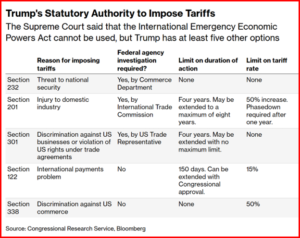
Last month, the US Supreme Court issued a verdict on the tariff lawsuit. The ruling invalidates a large portion of the tariffs that Trump implemented in 2025.However, there are other ways that he can introduce import taxes. Here’s a chart showing some of the other means these tariffs could be put back on the table:

Chart showing Trump statutory authority to impose tariffs after the tariff lawsuit

Source: Congressional Research Service, Bloomberg

Realistically, most affected tariffs will likely be reinstated by other means – and a temporary blanket 10% tariff already has. Trump has already ordered a raft of trade investigations that should allow him to enact more permanent tariffs, too.

While this could be good news for Canada, in the immediate future, it only increases uncertainty, further dampening consumer and business confidence and increasing the likelihood that spending decisions, whether for housing or business fixed investment, will be postponed.

Economic Insights from Dr. Sherry Cooper – Feb 2026

Economic News Jag Dhamrait 3 Feb

Economic Insights from Dr. Sherry Cooper on Canada trade diversification

Dr. Sherry Cooper shares economic insights on Canada’s trade diversification, global partnerships, and economic outlook.

Amid significant shifts in global trade dynamics, Canada is redefining its position on the world stage. While the United States continues to make headlines with its assertive trade policies, other nations—Canada included—are forging ahead, adapting and expanding their international relationships.

Last week, Prime Minister Mark Carney’s visit to Beijing marked the first Canadian prime ministerial trip to China since 2017, culminating in a landmark trade agreement. Canada lowered its tariff on Chinese electric vehicles, while China reciprocated by reducing tariffs on Canadian canola seed. Carney emphasized the importance of renewing and strengthening the Canada-China partnership, asserting that these efforts signal a move toward a new global order, with Canadian exporters increasingly seeking opportunities beyond the US market.

Impact on Economic Sectors

The prevailing uncertainty surrounding trade—driven by tariffs and shifting alliances—has contributed to a decline in housing market activity, particularly in Ontario and British Columbia. In contrast, Quebec’s housing market remains more robust, although tariffs on aluminum and lumber have dampened broader economic activity in the province and across Atlantic Canada.

Despite widespread concern about these developments, Canada’s outlook for broadening trading partnerships is stronger than many anticipate. The country possesses substantial competitive advantages that position it well to meet international demand over the next decade.

Canada’s Competitive Advantages

Canada’s strengths lie in its rich natural resources, including oil and gas, uranium, critical minerals, food and agriproducts, fresh water, and Arctic access. These endowments provide a solid foundation for trade diversification.

Historically, 75% of Canadian exports have gone to the US, with agreements like CUSMA offering tariff protections for many Canadian goods. However, recent developments and strategic initiatives are opening new opportunities, especially in the energy and agri-food sectors, where Canada’s geography, resource reserves, and trade agreements align with growing demand from Europe and Asia.

Cross-Cutting Advantages

Resource Endowments

Canada is a leading global supplier of scarce commodities, including crude oil, natural gas, potash, canola, and other agri-food products. Its status as the world’s largest producer of potash is crucial to the US fertilizer supply, and there is significant potential to expand exports to major importers like Brazil, India, and China.

Trade Architecture

Canada benefits from a robust network of trade agreements, including CETA with the EU and CPTPP with Asia-Pacific economies. These agreements lower barriers for exports to Europe and Asia, offering advantages over non-preferential competitors. The country’s trade strategy now aims for a 50% increase in overseas (non-US) exports, a goal already being met ahead of schedule in some sectors.

Reputation and Standards

Canada’s reputation as a politically stable, rules-based, and relatively low-carbon supplier is increasingly valued by global buyers prioritizing security of supply, especially in energy and food. This reputational premium is particularly important for European and Indo-Pacific customers seeking to mitigate risks posed by Russia and certain Middle Eastern suppliers.

Sectoral Opportunities

Oil and Gas: West Coast Egress to Asia

The Trans Mountain Expansion (TMX) and LNG Canada projects have significantly increased Canada’s pipeline and liquefaction capacity, providing direct access to Pacific markets. Since 2017, TMX has enabled a 130% rise in energy exports to overseas destinations, with LNG shipments reaching Japan, South Korea, China, and Malaysia. Chinese purchases of Canadian oil have reached all-time highs.

For North Asian markets, Canadian Pacific Coast LNG shipments are much faster than those from the US Gulf Coast, cutting approximately 20 days off voyages to South Korea. This geographic advantage, combined with Canada’s vast gas reserves and political stability, makes it a structurally competitive supplier to Asian gas markets.

Following the Ukraine conflict, Europe and Asia have strong incentives to diversify their energy sources away from Russia. Canada’s new export infrastructure directly supports this demand, with the global LNG market expected to remain tight through the mid-2020s, offering a window for new Canadian supply to secure long-term contracts.

Metals, Steel, Aluminum, and Autos: Input Strength vs. Finished Goods

Canada’s primary advantages are in upstream metals and minerals, such as iron ore and critical minerals, rather than in finished steel and automotive products. Metal and non-metallic mineral exports have grown rapidly—up about 74% since 2017—driven by gold and other metals.

For steel, aluminum, and auto parts, Canada’s ability to market low-carbon content and secure supply is a key differentiator, especially in jurisdictions tightening carbon and supply-chain regulations. While Canada’s participation in multiple free trade agreements provides tariff preferences in Europe and Asia, the integration and scale of the North American auto platform continue to present challenges for diversification in finished goods.

Agriculture: Canola, Potash, and Food Products

Canada plays a central role in global canola and potash markets and faces strong demand from large agricultural economies outside the US. The country supplies roughly 85–90% of US potash imports but is positioned to pivot toward growing markets such as Brazil, India, and China if US trade becomes less attractive.

China is a major buyer of Canadian raw canola seed and has greater processing capacity than other markets. Canada’s access to Asian and European trade channels further supports diversification. According to Farm Credit Canada, approximately $12 billion CAD in food and beverage exports could be redirected from the US to other markets or to domestic buyers, highlighting significant potential for reallocation.

Canada’s surplus potash supply helps keep domestic fertilizer costs low, allowing grain and oilseed exports to remain competitively priced in third markets. Combined with high standards for food safety and sustainability, Canada presents a compelling value proposition in premium and bulk agri-food markets.

Hydropower and Virtual Water

In the near term, “water exports” are primarily realized through hydroelectric power from resource-rich provinces, rather than bulk water shipments. These hydro resources support green power exports, particularly to the northeastern US, and may contribute to future cross-border electricity grids.

As climate risks grow, Canada’s abundance of water and arable land creates long-term advantages in producing water-intensive goods such as grains, oilseeds, forestry products, and certain metals—positioning the country to supply water-stressed regions globally.

Policy and Political Economy

Canada’s federal strategy now explicitly positions trade diversification as central to risk management and economic resilience. Dedicated tools and financing, including Export Development Canada and trade commissioner services, are helping exporters access non-US markets. Combined with private-sector investments in logistics and port capacity, these efforts continue to reduce the costs and barriers associated with reorienting exports.

Conclusion

Canada’s structural advantages enable a gradual reduction in marginal dependence on the US, particularly in energy, agri-food, and some metals and advanced manufacturing sectors. However, full substitution in autos and certain processed goods remains unrealistic and inefficient due to the deep integration of the North American market. Overall, Canada’s expanding network of trading partners and robust resource base position it well for a resilient economic future.

As these successes mount, Canadian consumer and business confidence will rise, re-igniting pent-up demand in housing. As we move through this transition year, optimism will mount, and reduced housing prices, combined with lower mortgage rates, will return housing activity to more normal levels in the hardest-hit provinces of Ontario and British Columbia.

Economic Insights from Dr. Sherry Cooper – December 2023

Economic News Jag Dhamrait 5 Dec

Economic Insights from Dr. Sherry Cooper – December 2023

As we move into year-end, we have every reason to believe that the economy has slowed and inflation, while still above target, has dropped significantly. But slower inflation does not mean falling prices in most markets. Yes, gasoline prices are down, and food inflation has slowed, but the purchasing power of households has not improved.

Consumer confidence is down as many households fear their mortgage renewals, where rising monthly payments will dig even deeper into their discretionary income.

Mortgage arrears are still at historical lows, but credit card and auto loan delinquencies are rising. Housing markets have slowed considerably, even as lenders cut their fixed mortgage loan rates. Declines in variable-rate loans generally await an easing in monetary policy by the Bank of Canada, which is still likely at least six months away.

The good news is that interest rates have likely peaked. So far, the economy is on a glide path for a ‘softish’ landing. I doubt we will see two consecutive quarters of negative growth. And, if we do, the central bank will respond sooner with rate cuts.

The fiscal authorities’ hands are tied. Many accuse Ottawa of increasing budgetary red ink too quickly over the past eight years, especially during the pandemic. Now that market-determined interest rates have risen sharply, the debt financing costs are spiking. The Liberals’ popularity is waning, and while business is calling for investment tax credits and everyone wants more affordable housing, the feds can only marginally affect these issues, given budgetary and political constraints.

The latest gimmick is to reduce short-term rentals by restricting Airbnb properties in some ways, but that will again have a meagre impact. Encouraging construction with GST elimination and cheaper credit is helpful. Still, even if they do lead to 30,000 new rental properties, that’s a drop in the bucket when planned permanent immigration is slated for 500,000 people per year.

The real rebound in economic activity is coming when the BoC signals it will cut the overnight policy rate. In the meantime, it is now a buyers’ market in many localities as home prices decline. The spring housing market could show a meaningful pickup in anticipation of lower rates and more housing supply. Motivated sellers will be out there, and buyers can pre-approve and take their time finding the right fit. The multiple-bidding wars are over. The housing market will lead the economy upward next year.

Economic Insights from Dr. Sherry Cooper – November 2023

Economic News Jag Dhamrait 1 Nov

The Canadian economy is showing continued signs of slowing as inflation decelerates. This opens the door for a continued pause in rate hikes. Indeed, with any luck, the Bank might have finished its tightening cycle.

One more rate hike is possible, especially if continued Middle East tensions lead to a sustained oil price increase, but the odds are against it.

This does not suggest, however, that interest rates will decline anytime soon. Headline inflation in September was posted at a 3.8% year-over-year pace, well above the Bank’s 2% target. Wage inflation remains at roughly 5%, and inflation expectations remain high.

However, the economy is slowing, and excess demand in labour markets is waning. Third-quarter economic growth is likely to be less than 0.5%, and leading economic indicators are pointing to a further slowdown in the final quarter of this year and the first quarter of 2024.

Canadian consumers, weighed down by record debt loads and high prices, are tightening their purse strings. Savings rates have fallen, and retail sales per capita have slowed markedly. Sales were down in six subsectors: car dealers, furniture, electronics, and appliance retailers.

Canadians are quickly rolling back their purchases of goods as more households face mortgage payment renewals. The Bank of Canada consumer survey suggested that families expect more adverse effects ahead as an increasing volume of mortgages come due for renewal or refinancing.

Businesses are also tightening their belts as the recent Bank of Canada Business Outlook survey showed considerable weakness. The Bank is counting on softening demand to translate into a slower inflation rate in the coming months.

I expect the central bank to cut interest rates in mid-2024, gradually taking the overnight policy rate down. In the meantime, housing markets will continue seeing a surge in new listings and more favourable buying opportunities.

Fall Market Forecast

Economic News Jag Dhamrait 1 Oct

As we round the corner into October, now is a great time to touch base about what to expect in the marketplace this Fall!

As you may have heard, The Bank of Canada opted to maintain its policy rate at 5% as of September. The recent rate hikes over the spring and summer have slowed the housing and mortgage markets as potential buyers were unsurprisingly spooked by the rise in mortgage rates.

More recently, fixed-rate loans have become more expensive because of the rise in longer-term interest rates. As a result, housing affordability became a bigger hurdle and led to a slight decrease in home prices by 6% in major markets over the summer.

With The Bank of Canada currently maintaining the 5% policy rate, many hope this will be the peak in overnight rate changes. If so, homeowners and potential buyers will be granted some breathing room. We will find out more with their upcoming announcement on October 25th.

As we turn the corner into Fall and start looking ahead to the coming year, analysts are forecasting stronger housing markets. The expectation is that The Bank of Canada will gradually cut interest rates by mid-year, allowing potential buyers to better navigate their affordability.

As the housing supply shortage continues, new listings are likely to rise and provide much-needed new inventory. As we move into 2024 and start to see interest rates decrease, motivated sellers will move off the sidelines and housing demand is expected to be resilient.

For anyone who is thinking about purchasing this season, it is important to get pre-approved to guarantee your interest rate for 90-120 days while you shop the market. This way, you will avoid being impacted by potential rate changes and can properly estimate your budget for mortgage costs. Plus, pre-approval will indicate to the seller that you will not have issues obtaining financing (assuming nothing changes between now and the purchase with your job, savings, etc.), which is key during the current economic landscape.

To help you make the best decision possible, download the My Mortgage Toolbox app to determine what you can afford, and what your mortgage would look like at various interest rate levels.

I am also here to provide expert, unbiased advice to anyone with concerns, questions or wanting to get started on their pre-approval today!

Economic Insights from Dr. Sherry Cooper – September 2023

Economic News Jag Dhamrait 1 Sep

The Bank of Canada has a single mandate—to ensure that inflation returns to the 2% target. This means that the Bank will raise interest rates if inflation is too high and lower interest rates if inflation is too low.

The U.S. Federal Reserve, in contrast, has a dual mandate—to maximize employment given a 2% target for inflation.

That is a subtle but meaningful difference.

July inflation data showed that the headline CPI inflation rose to 3.3%, up from 2.8% in June. One challenge in understanding year-over-year inflation data is base effects. Base effects occur when the current year’s inflation is compared to the previous year’s inflation, called the base year. If the base year has unusually high inflation, then the current year’s inflation will appear lower than it is.

For example, inflation in Canada was very high in June 2022. This means that inflation in June 2023 appeared to be lower than it is, even if there is no change in the underlying level of inflation.

Gasoline prices peaked in June 2022 and trended downward for most of the year. That makes y/y comparisons look worse starting last month. If you are only focusing on the annual change in inflation, you will be misled.

Looking at monthly changes in the headline inflation data can also be misleading because so many components of headline inflation are highly volatile. For example, monthly consumer prices in July rose 0.6% compared to only 0.1% in June. The y/y increase was smaller for core inflation measures. And if you exclude food, energy and mortgage rates, y/y inflation was quite moderate.

The main point here is that it’s complicated. I am more sanguine about last month’s inflation data than most Bay Street economists. The overall Canadian economy has slowed. Following the strong first quarter growth of 3.1%, Q2 GDP growth will likely come in at around a much more muted 1.2%. Job vacancies have fallen for a year, and the unemployment rate has risen to 5.5%–still low by historical standards but up from the record low this cycle of 4.9%.

The single major economic release ahead of the September 6 Bank of Canada policy decision is Q2 GDP, released on September 1. The BoC is expecting growth of 1.5%.

The impact on the economy of higher interest rates has a long lag. The full effects of the tightening will not be evident for a few more years. Given that most Canadian mortgage borrowers renew their mortgages every five years, the largest impact is yet to come. Nevertheless, higher interest rates have slowed the most interest-sensitive sectors.

Canadian new home prices edged down 0.1% in July, deepening the year-over-year decrease to 0.9%. In the same month, the yearly decline in the benchmark price of an existing home (as measured by the MLS HPI) eased to 1.5%. While prices for existing homes are still rising modestly, the momentum looks to have slowed as the market returns roughly to balance following the Bank’s latest two rate hikes.

Barring a massive upside surprise in Q2 GDP, the central bank will leave the policy rate unchanged at 5.0%. Longer-term market rates, however, have been rising, boosting fixed-rate mortgage yields. This results from economic and political concerns in the U.S. There is a good chance that overnight rates in Canada have peaked. If the economy remains too strong, the Bank will keep the door open for further tightening as inflation exceeds the 2% target.

Economic Insights from Dr. Sherry Cooper – August 2023

Economic News Jag Dhamrait 1 Aug

The Bank of Canada remains staunch in its battle against inflation, utilizing its primary weapon—the overnight policy rate—which has escalated from 25 basis points to 500 bps since March 2022.

This historically low overnight rate was a direct consequence of the COVID-19 pandemic and implementing measures to cushion the economic impact of the lockdowns. These initiatives included reducing the policy rate from 1.75% to 0.25%, postponing mortgage payments, providing financial support to businesses for workforce maintenance, and compensating individuals for home quarantine. These measures, amongst others, reignited the economy upon the widespread availability of the vaccine.

The Canadian economy bounced back robustly once commercial activities resumed. Employment rates rocketed, and unemployment plummeted to all-time lows. However, the recovery faced a setback when Russia invaded Ukraine in February 2021, which caused supply constraints, and substantially increased energy and food. Despite the soaring inflation, central banks were initially hesitant to take action.

In hindsight, we now know the necessity for initiating interest rate hikes by mid-2021. Instead, this action was postponed until March 2022.Furthermore, the Bank of Canada and other significant central banks inundated the financial system with surplus liquidity by purchasing government bonds. This quantitative easing tactic made capital not only more affordable but also readily available, sparking an unprecedented boom in the housing market.

Many exploited the record-low rates of 2020 and 2021 by opting for variable-rate loans due to their lower costs. At its zenith, variable-rate mortgages (VRMs) accounted for 57% of all loan originations. These loans are due for renewal in 2025 and 2026. However, most of these loans have reached their trigger points and are negatively amortizing, barring substantial lump-sum payments by borrowers.

For those who chose adjustable-rate loans, monthly payments increased with every Bank of Canada rate hike. Delinquency rates, for the time being, remain impressively low within the prime space, though they are beginning to rise among alternative lenders.

After reaching a zenith of 8.1% in June 2022, inflation has slowed to 2.8% in June of this year. Regardless, the Bank of Canada continued its trend of interest rate hikes following a brief hiatus in its last two meetings, with speculation of another hike in September. The Bank has provided a buffer period for itself by projecting a return to the 2% target inflation rate by mid-2025—a considerably more extended period than initially anticipated.

The recent rate hikes and moderated expectations appear prudent considering the Bank’s preference for mitigating inflation over preventing a recession. It is improbable that the Bank of Canada will reduce interest rates this year.

Although the policy rate is projected to decrease in the first half of 2024, it is not expected to return to the pre-COVID level of 1.75%. Negative real interest rates (the actual market rate minus the 2% inflation rate) are unlikely to occur, barring a global economic meltdown.

Economic Insights from Dr. Sherry Cooper – July 2023

Economic News Jag Dhamrait 4 Jul


The biggest surprise recently has been the unexpected interest rate hike by the Bank of Canada. While the April inflation headline did tick up, and Q1 GDP data came in at a stronger-than-expected 3.2%, the April labour force data showed some easing in the jobs market.

The ratio of unemployment-to-job vacancies is now rising. Rather than signalling a rate hike before the announcement on June 7, the Bank chose to pre-empt any additional economic indicators.

Ironically, the May jobs data, released later that week, showed a rise in the unemployment rate to 5.2%, the first increase since before rate hikes began in March of last year. The Bank of Canada was particularly disturbed by the resurgence in home sales and prices in April. They argued that interest rates needed to be higher if the most interest-sensitive of all spending was rising.

That move by the central bank spooked the housing market, causing many to question their decisions to purchase. Expectations of any declines in the overnight policy rate this year vanished, and markets now expect at least one more hike this year.

Consumer spending does remain robust, as evidenced by the solid retail sales data for April. Moreover, many households have turned to credit cards to finance their spending—bolstered by inflation—and delinquency rates have risen.

Wage inflation remains strong, core inflation ticked up in April, and food inflation, though down from double-digit levels, is still far higher than a 2% inflation target would warrant.

The bank watchdog, OSFI, warned that the rising level of remaining amortizations of variable rate mortgages is a warning sign of continued risk for households that went into VRMs in droves when interest rates plunged in the first two years of the pandemic. New originations over that period were at rock-bottom rates, and variable mortgage rates were far below fixed. The situation has reversed today, and 3-to-4-year fixed mortgages dominate new mortgage originations.

Many VRM borrowers have hit their trigger points, where their monthly payments are no longer covering their interest costs—hence the negative amortizations of these loans at some Big Six Banks. OSFI is warning banks to address this immediately as renewals will mean at least a 30% rise in monthly payments if mortgage terms revert to 25- or even 30 years. OSFI has also increased the mandatory level of Tier One common equity relative to risk-weighted assets by 50 basis points. Currently, all the large Canadian banks fulfill this requirement.

Another significant milestone last month dramatically impacted the Canadian housing market. International migration to Canada spiked in 2022, taking population growth to 2.7%, the highest in the developed world and the strongest since the top of the Baby Boom in 1957. As of mid-June, Statistics Canada announced that the population is 40 million. The housing shortage is mounting, and housing starts are falling. Despite higher interest rates, demand for housing for rent or purchase has never been more robust.

While the federal government announced last year that they want to double housing construction to improve affordability over the next decade, Trudeau’s goal appears unachievable. This will continue to put upward pressure on rents and home prices over the longer term.

Economic Insights from Dr. Sherry Cooper – June 2023

Economic News Jag Dhamrait 1 Jun

Image of Dr. Sherry Cooper from Dominion Lending Centres
 

Once again, the Canadian economy is running hotter than expected by the Bank of Canada. The economy continues to exhibit excess demand conditions. In particular, labour markets are very tight, the unemployment rate is near a record low, and wages are rising by more than 5%.

Consumer spending is still strong, and the housing market has bounced considerably. Home sales were up 11% in April, prices are rising again in many regions, especially the GTA and GVA, and new listings are so slim that it is now a sellers’ market. This should bring some potential sellers off the sidelines in May and June. However, demand is likely to remain well more than supply, given the influx of many immigrants and the constraints on the construction of new housing.

The April inflation data was stronger than expected at 4.4%, indicating that the mid-year forecast of 3% might well be overly optimistic. Some are already calling for a rate hike by the central bank this month or in July. While that might be premature, the Bank will consider at least one more increase in the overnight policy rate if the May data is robust.

This is at a time when homeowners are already feeling the pinch of the rapid rise in interest rates over the past year. Homeowners who bought in 2020 and 2022 and financed with variable-rate mortgages are already under pressure. And those with fixed-rate mortgages will refinance at substantially higher interest rates.

Already, many households have monthly payments that do not cover the interest on their loans, let alone the principal. Many lenders are allowing extended amortization. CMHC announced they would not extend the amortization of newly insured mortgages beyond 25 years.

One thing is sure. Do not expect monetary policy easing any time this year.

Economic Insights from Dr. Sherry Cooper – May 2023

Economic News Jag Dhamrait 1 May

Image of Dr. Sherry Cooper
 

It has been just over a year since the Bank of Canada started hiking interest rates. While the economy has remained surprisingly resilient, the housing market has weakened sharply.

The Bank has remained on the sidelines for the past two Governing Council announcement dates, and home sales have edged upward in very tight markets.

There is a rapidly growing housing shortage. As population growth remains strong and immigration targets rise, new home construction cannot keep up with demand. Demand for rental properties is surging, and rents have risen sharply for new tenants.

Another factor that could slow the economy this year is the rise in monthly housing payments. For those with adjustable-rate mortgages, monthly payments have already risen sharply. Most of those with variable-rate loans with a fixed monthly cost has hit their trigger point, and the amount no longer covers any of the principle. Most banks have allowed negative amortization but will require borrowers to return to original 20-year amortizations upon renewal. This could be quite a shock to consumers over the next few years.

The Office for the Superintendent of Financial Institutions is very concerned about the risk associated with these loans. We will be hearing soon from OSFI regarding more restrictions on mortgage lending.

The great news is that inflation is falling quickly, down to only 4.3% in March. The central bank expects inflation to fall to about 3% by the end of this year. So, barring unforeseen inflation pressures, the Bank could pause for the rest of this year. Rate cuts, however, are unlikely until 2024.

The Canadian economy will likely slow as the year progresses. The most likely scenario is a mild recession later this year. As we move into 2024, interest rates will slowly decrease to about 2.5% for the overnight policy rate. The economy will rebound, and the Bank of Canada expects to hit its 2% target on inflation. That might be hard to achieve, given rapidly rising wages and continued inflation expectations.

12