Small Extra Payments = Big Mortgage Wins

Mortgage Tips Jag Dhamrait 29 Jun

Young woman using smartphone while reviewing documents at home. Pay down your mortgage with small extra payments and prepayment strategies

Small extra mortgage payments can make a big difference over time by helping reduce interest and shorten your amortization.


Having some extra cash on hand might give you some breathing room on rising gas and food prices, building an emergency fund, or even the ability to make a big purchase you’ve delayed. But – should you pay down your mortgage instead? If you’re considering paying down your mortgage, you’re in luck, because today we’re going to look at how a lump sum payment can transform your mortgage future.

Base Case Scenario

Here we’re going to look at a mortgage with a $500,000 balance at a rate of 4.99% and a 25-year amortization. In this scenario, your monthly payment would be $2,905.18. If we fast forward 25 years to the end of that mortgage, having made no lump sum payments, you’ll have paid $371,554 in interest and a total of $871,554 in payments for your $500,000 mortgage. Although your rate will vary over the course of your mortgage, in this example we’re going to keep it consistent at 4.99%.

Payment Options

When we’re talking about paying down your mortgage early, there are three main ways you can do this. The first is to save a lump sum of cash, which you put down all at once, one time per a year (for example, on your mortgage anniversary). You don’t have to make this payment every year, but you likely have the option to put down a flexible amount of cash with upper and lower limits every year of your mortgage.

The second option is to round up your regular payments to a set amount. Again, there will be upper and lower limits on how much you can pre-pay, but you’ll likely be able to round up by a couple hundred dollars or to the nearest $100, for example.

The third option is to go with accelerated payments, which are normally offered weekly or bi-weekly. Here the lender will calculate the specific amount for you.

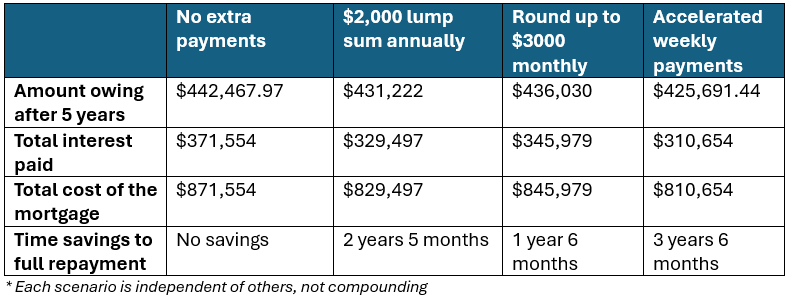
Each of these options will help you pay less in interest over the lifetime of your mortgage, with varying impact on the total amount of interest. Below is a chart showing how these three prepayment types can change your mortgage.


As you can see, even a small monthly increase in your payment can save you tens of thousands of dollars on your mortgage. The biggest impact you can make on your own financial future is to change your payment frequency – the more often you pay, the less interest you pay, and the sooner you pay off your mortgage in full! Even if you don’t have a new mortgage, you can start any of these strategies at any time.  Whenever you do start prepaying, you’ll start saving time and money over the rest of the term of your mortgage.

Be Aware: It’s important to consult your lender about what prepayment types and amounts allowed within your current mortgage. Many lenders set prepayment amounts as a percentage of your outstanding mortgage balance, although some lenders offer more unique options like doubling a payment.

If you want to run this scenario for your own mortgage, with whatever numbers you have, and different prepayment amounts, I’ve got great news. You can download my app and do it all – easily and for free – whenever you want. And if you have questions, you can DM or call me right in the app for help!

Home Décor Trends to Elevate Your Space

Home Tips Jag Dhamrait 24 Mar

Home décor trends with blue kitchen cabinets and modern finishes

A contemporary kitchen renovation remodeling featuring a center island, hardwood floor and quartz counter.

Minimalism is dead.

In 2026 we’ve moved on, adding colour, vibrancy, new features and personality galore into our homes.

Here are the biggest trends you can keep your eyes (and budget) set on this year:

Grandma Chic: If your birth year starts with 19, you’ll probably feel nostalgic about this trend. Things like florals, ruffles and pleated skirts are back on couches and chairs. Lamp shades, antique clocks, China cabinets and anything else you saw in your grandma’s house in the 80’s is back in style. Your entire house doesn’t need grandma’s approval, but it’s time to proudly and stylishly display any heirlooms she passed down.

Dark Design: Terracotta, dark green, chocolate brown, darker woods… the stylish home has plenty of these colours in 2026. If you want to try it, consider painting your existing cabinetry, adding a chair or couch in a moody shade, or even choosing an area rug that does double duty in style and function while it hides the fact you haven’t vacuumed this week (or month).

Feeling Blue: Blue may not be the Pantone colour of 2026 – but it’s everything in fashion, design, social media content, makeup, even dining. Any shade will do, from icy to electric. It’s super easy to add to your home with things like furniture, dishes, artwork, rugs, or even knickknacks (those are back too… keep reading).

Bidets: Thanks to the explosion in bidet popularity, it’s easy to find an attachment, toilet seat, sprayer or entirely new toilet to bring the bidet lifestyle into your home. Plus, they reduce toilet paper use, saving your home plumbing and the environment! They’re fairly easy to install yourself so if you’re keen on trying one, a trip to your local hardware store is probably all you need.

Walls Are the Art: Wallpaper is back, baby! There are infinite cool patterns and colours to choose from, including some really interesting and personal choices. And don’t forget the fifth wall to every room – the ceiling! Paint it or wallpaper it too, adding drama, interest, and even heights to the space.

Personal Storytelling: This unique approach is about telling your own story, piece by piece. Any room can feel welcoming because nothing is too precious or perfectly styled. It won’t happen overnight though. It’s a rebellion against fast fashion and staged decorating, as you collect everything over your lifetime rather than in one trip to Pottery Barn. Display your travel souvenirs, favourite knickknacks, unique furniture and thrifted gems and enjoy sharing a memory or telling an origin story of your favourite treasures to your guests.

What’s Out

If you’re looking to thoughtfully declutter as you modernize or redecorate your home, here are the top three things to part with.

  • Fake plants. And its cousin, the 2000’s oversized vase with dried wheat.

  • Mass produced wall art. That print of le chat noir or Campbell soup are heading for retirement (or the attic for when they come back in style).

  • Word art. We don’t live laugh or love this look anymore.

I’d love to hear what interior decorating styles and trends you have going on – and if you’re looking at any of these trends to update your existing style. If your home needs a bigger upgrade than just some new design elements, I can always help you sort through the financing options. Call text or email me anytime!

Reverse Mortgages: A Modern Tool for Retirement Planning

Mortgage Tips Jag Dhamrait 23 Feb

Loving senior couple smiling in front of their house. Reverse mortgage retirement planning for Canadian homeowners 55 and older

A reverse mortgage can help homeowners 55 and older access home equity while continuing to live in their home.

Visualize this: It’s 1986. You’re an accountant in Vancouver. You’re seeing seniors living longer, healthier and more self-sufficient lives than ever. But they don’t have enough cash to pay their day-to-day expenses.

You want to help them. So, you create a financial product that lets them access home equity without giving up ownership.

You call it… the Canadian Home Income Plan, and lovingly refer to it as a CHIP. Your product – a reverse mortgage – gives seniors a way to stay in their homes, access the equity without selling, and have complete flexibility and control over the funds. It has a slow start, but over the next decade it catches on across Canada.

Fast forward to 2026 and the reverse mortgage has evolved into a useful tool for so many Canadians. We’ve seen a 40% increase in usage of reverse mortgages in the past 3 years alone! There are several reasons for this, including skyrocketing property values, inflation driving up the cost of living, people living longer and healthier after retirement, and a whopping 71% of those over 75 still owning homes. So, older Canadians are opting to supplement their income with home equity to maintain or improve their standard of living in retirement.

What are the Basics of a Reverse Mortgage?

A reverse mortgage is available exclusively to homeowners aged 55 and older; all applicants must meet that minimum age. You can access anywhere between 15-55% of the value of your home, with your age and the location playing the biggest roles in the amount.

With a reverse mortgage, you can take out money in four different ways:

  1. Use it like a line of credit
  2. Take out a lump sum of cash at any time
  3. Arrange regular ongoing monthly payments
  4. Use a combination of options 2 and 3 above

Also of note is that you must live in the home, maintain the property, and ensure property taxes and insurance are both paid and current. You can get up to 3 reverse mortgages and even qualify for one on multi-unit properties (up to 6 units).

What are the Benefits?  

A reverse mortgage doesn’t depend on your credit score or your income for qualification. In fact, you don’t need to have any income at all! You also maintain complete ownership of your home and continue to live in it and build equity.

Another set of benefits are that the funds aren’t considered income, so they’re not taxed and don’t impact any pension or benefits you qualify for. You can even use this as part of your tax strategy (do consult a financial planner about this though).

What Can I Use a Reverse Mortgage for? 

These funds are extremely flexible, so you can use them for nearly anything. A few common ways Canadians use them are:

  • Home renovations or upgrades
  • Helping family (like a gifted down payment, a living inheritance, or a paying for a wedding)
  • Buying another property
  • Paying off higher interest debts
  • Funding your lifestyle, a vacation, or other expenses

What Will a Reverse Mortgage Cost?  

There are two types of costs you’ll encounter with a reverse mortgage.

First, like any mortgage, you’ll be charged interest. The rates are typically 1-2% higher than a regular mortgage, but you have the same flexibility with fixed or variable rates in various terms.

Second, you’ll have upfront costs to fund the reverse mortgage. You’ll need to get independent legal advice, an appraisal on your home, and you’ll most likely pay a lender or setup fee. Those three items will typically cost $1500 – $3000. You might be able to negotiate the rate or even find a promotion that waives the setup fee, so using a mortgage professional to shop around could save you money.

How do I Get Out of a Reverse Mortgage? 

Much like a regular mortgage, you can pay off the amount owing in full at the end of the term without penalty. You can also make regular payments to bring down the balance. Lenders may also impose early repayment fees depending on the terms and conditions.

Alternatively, if you sell the property, you repay the amount in full at the time of sale. In the case of death, your reverse mortgage must also be repaid in full, before your estate is disbursed.

Are Reverse Mortgages Regulated? 

Yes. The industry is regulated by the Office of the Superintendent of Financial Institutions (OSFI). They’re considered a non-recourse loan, meaning you’ll never have to repay more than the property is worth or sold for. You often see this feature advertised by lenders as a ‘no negative equity guarantee’, but know that’s a legal requirement here in Canada.

Are Reverse Mortgages a Scam?  

No. They’re a legitimate and useful way for people to access home equity without selling their home. They’ve been approved and endorsed by the Canadian Association of Retired Persons (CARP), and members can even qualify for a $250 fee rebate upon funding. Plus, the Ontario Teachers Pension Plan invests in one of the main reverse mortgage companies.

However, like any financial product, the reverse mortgage market sees its share of scams. Be sure to use a licensed and experienced mortgage professional to avoid them. Look out for anyone one asking you to sign over the title to your home (never do this), or contractors offering to do the paperwork and get funding for you to fund upgrades or renovations. Those are big red flags!

Are there Alternatives to a Reverse Mortgage?

You always have options! A Home Equity Line of Credit (or HELOC) lets you take out equity and offers up to 80% of the value of your home (although you need income to qualify). You could also sell your home and downsize, rent, or move into another type of residence. No matter what route you go, you’ll want to look at the total cost of each option to help you make the best decision.

What Are the Next Steps to Getting a Reverse Mortgage? 

I’d love to help you explore your options. There are several Canadian financial companies that offer reverse mortgages in 2026, each with different fees, requirements and features. I would be happy to compare them and help you pick the best choice for your unique situation. Let’s set up a call to discuss.

Valentine’s Day Your Way

Home Tips Jag Dhamrait 14 Feb

Valentine’s Day ideas with child and dog decorating cookies at home

Valentine’s Day does not have to be fancy. Simple activities at home can make the day feel fun, relaxed, and personal.

Roses, chocolates and cards not doing it for you in 2026? You’re not alone! But even if you are, you’re still welcome!

Here are my best suggestions to enjoy Valentine’s Day without the pressure of a fancy dinner out or even another human to share it with.

For the foodies: Bake a batch of sugar cookies and decorate them – either with cute red and pink hearts, or black bows and arrows. There are no rules here! Or, try out a mixology or cooking class online and learn how to make something new and delicious.

For the active folk: Draft a checklist of festive or un-festive items (like someone in a red coat, a squirrel, a restaurant with a line, a house with Valentine’s décor, a hockey jersey, an amazon truck, etc.) and go for a walk outside until you find everything on your list. Or, lace up your skates and stuff your pockets with candy or hot chocolate to fuel an outdoor skating session.

For a group: Invite your galentines or palentines over for a game of Catan, Blokus, Wizard or Hues and Cues. Or, make a reservation for your group at a board game café and play as many as you can.

For the anti-consumerists: Write some poetry (here’s how if you’re a newbie), then do a light hearted reading of your work (people, pets, or your camera are all great audiences). Or, do some volunteering at an animal shelter, food bank, or wherever else speaks to you; give back instead of giving gifts!

For the gardener: Make wildflower seed bombs. Combine equal parts wet clay (or half the amount if you have dry clay) and soil (or a compost mix). Gradually add water until you get a dough-like consistency. Then, add in your seeds (about a teaspoon per handful of concoction) and form them into balls or pucks. Let everything dry until early spring and then toss the seed bombs wherever you want those flowers to grow (no need to plant/bury!).

If you want to make it more Valentine’s Day themed, add some pink or red food colouring to the dough and shape your bombs into hearts. Lovely.

Estate Planning: Are You Covered?

Personal Finance Jag Dhamrait 27 Jan


“New Year, new you” may be a cliché but it is for a reason! The New Year always has us thinking about where we are now, and where we want to end up. When it comes to your personal goals, a review of your finances and estate should be at the top of your list.

Proper estate planning can ensure that you have a stress-free year knowing you are covered!

Is your will up-to-date?

The purpose of a will is to outline your assets and determine how they will be distributed, as well as who will be in charge of managing affairs. Some key components to include in this document are:

  • Up-to-date list of your significant assets; note the location if outside your province or outside Canada.
  • Who will inherit your assets? And which?
  • Outline of where you want assets to pass outside your estate to avoid probate fees (e.g., an insurance policy, an RRSP)? Do this via beneficiary designation.
    • If they are minors, do you have a trust or other provisions in place?
  • Is the list of beneficiaries in your will up to date? Have there been recent births, deaths or marriages in your family?
  • Have you included alternates in case your named beneficiaries predecease you?
  • Do you want to give to charities or other organizations?
  • If you have children, have you indicated a guardian and spoken to them?
    • Did you include an alternate in case the guardian you chose is unable to commit?
    • Have you reviewed your choice of guardian as your child grows older?
  • Your executor who will carry out your wishes after you die. You can name one executor or two or more co-executors. Be sure to name one or more alternates as well.

Have you assigned a power of attorney?

Another important (and often overlooked!) aspect of estate planning involves naming a power of attorney. This individual is someone you trust to make decisions for you should you become unable to do so due to injury or illness, whether temporary or otherwise.  Power of attorney documents are created for you by a wills and estates lawyer (or notary in Quebec) as part of your estate plan.

Do you have mortgage protection insurance?

Through Manulife Mortgage Protection Plan (MPP), you have the opportunity to add a portable insurance policy to your mortgage that helps protect your loved ones and your home should something unexpected happen to you.  Unlike bank insurance, MPP is a portable life and disability product that you can take with you, from lender to lender and property to property.  This gives you the utmost future flexibility and is unlike bank insurance products which tie you down exclusively to them.  To ensure you get the best rate at renewal, you must have invested in an insurance product like MPP that will give you the freedom to move!

Mortgage life insurance will protect your family’s future by paying out your mortgage should the mortgage holder pass away. Manulife will also make your mortgage payments while your claim is being adjudicated, so there is no added stress for a loved one at an already difficult time.  Mortgage disability insurance will take care of your mortgage payments plus property taxes if you become disabled.  Disabilities from sickness and accidents are relatively common and will affect 1 in 3 borrowers throughout their mortgage amortization.  Manulife provides budget-friendly payment options, the ability to top-up your coverage and so much more.

These are all important aspects to consider to ensure your estate and family will be provided for should something happen. While never a fun topic, it is an important one and the better prepared you are, the better off your loved ones will be.

I would be happy to discuss coverage with you to ensure peace of mind for your family and their future.

Ice to Meet You: Build a Skating Rink in Your Own Backyard

Home Tips Jag Dhamrait 20 Jan

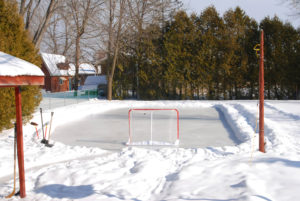
Backyard skating rink at home with snow and hockey net

A common winter scene of a backyard hockey rink in Canada

A skating rink in your own backyard? Yes, please!

A skating rink is a great way to keep kids busy, stay active yourself, entertain guests, or even use as a conversation-starting background to your social media content. Here’s how to make this easy, enjoyable feature at home this month.

  1. Get a tarp: You’ll need to line the area you want to skate on with a heavy-duty tarp. You can get all kinds of sizes, so pick one that suits the area you’re looking to cover. Amazon is an easy destination but a hardware store might be a better bet so you can see and feel the quality before buying. If you think you want to make this rink year after year, consider investing in a quality tarp from heavydutytarps.ca.
  2. Frame the area: Set up a border for your rink using wood you have – scraps, 2x4s, logs, whatever! You can also buy long boards at that same hardware store you’re shopping for your tarp at if you don’t have something suitable at home already. Keep the frame secure with brackets or angles. Alternatively, you can use snow for a frame – just be sure it’s firmly packed and fully covered by the tarp. The frame should be a bit smaller than the tarp’s area, as you’ll want the tarp to come at least 10cms up the sides.
  3. Flood your rink: Use your backyard hose to flood the area until it’s at least 5 centimeters deep. Now the hard part – wait for it to fully freeze.
  4. Decorate your creation: Use strings of outdoor lights to illuminate your rink so it can be used well into the evening. Other fun additions are folding chairs with blankets, an old scrap of carpet where you can put skates on and off, a portable fire pit, a cooler to keep your beverages in, or even an outdoor patio lamp style heater (just not too close to the rink!).

I hope you give this a try – and don’t let my invite get lost in the mail if you do!

Pantone Color 2026: Cloud Dancer & Mortgage Clarity

Home Tips Jag Dhamrait 14 Jan

Pantone color 2026 Cloud Dancer mortgage renewal strategy

Pantone’s 2026 Color of the Year is Cloud Dancer, PANTONE 11-4201

Pantone color 2026 is Cloud Dancer, a soft and calming white that reflects clarity, quiet reflection, and a fresh reset.

As we enter a new year, that message feels very relevant for many homeowners. After years of rising costs, shifting interest rates, renewal pressure, and tighter household budgets, many Canadians are not looking for more noise.

  • They are looking for clarity.
  • They are looking for breathing room.
  • They are looking for a better mortgage strategy.

What Cloud Dancer Represents

Pantone’s Color of the Year is more than a colour trend for design, fashion, or home décor.

Each year, Pantone selects a colour that reflects the mood of the moment and the world around us. For 2026, Cloud Dancer represents calm, simplicity, and the idea of creating space to think clearly.

That same idea can apply to your finances.

When life feels busy or uncertain, it can be easy to leave your mortgage on autopilot. However, your mortgage is often one of the largest financial commitments you will ever have. It deserves more than a quick signature at renewal time.

Why 2026 Is a Good Time for a Mortgage Review

A mortgage review in 2026 may be especially important if your renewal is coming up, your monthly payments feel tight, or you are carrying higher-interest debt.

Many homeowners focus only on the interest rate. While the rate matters, it is only one part of the bigger picture.

Your mortgage strategy should also consider your payment structure, cash flow, debt obligations, future plans, and overall financial comfort.

For some homeowners, the right move may be renewing with their current lender.

For others, it may be refinancing, consolidating debt, adjusting the amortization, exploring a different lender, or restructuring the mortgage to better support monthly cash flow.

The key is not to guess.

The key is to review your options before making a decision.

A Fresh Start Does Not Always Mean a Big Change

Cloud Dancer is a reminder that a reset does not always need to be dramatic.

Sometimes, a fresh start simply means slowing down, asking better questions, and making sure your mortgage still fits your life today.

  • Your income may have changed.
  • Your expenses may have increased.
  • Your debts may look different.
  • Your family goals may have shifted.

Your mortgage should be reviewed with those changes in mind.

Before You Sign Your Renewal Offer

If your bank sends you a mortgage renewal offer, it may feel easy to sign it and move on. But before you do, it is worth taking a closer look.

Ask yourself:

  • Is this the best structure for my current situation?
  • Can I improve my monthly cash flow?
  • Should I consolidate higher-interest debt?
  • Does this mortgage still support my short-term and long-term goals?
  • Are there better options available through another lender?

A mortgage renewal is not just paperwork. It is an opportunity to reset your strategy.

Make 2026 a Year of More Clarity

Pantone color 2026, Cloud Dancer, is all about calm, clarity, and creating space.

That is exactly how your mortgage planning should feel.

  • Less confusion.
  • Less pressure.
  • More understanding.
  • More strategy.
  • Better decisions.

If your mortgage is coming up for renewal, your payments feel tight, or you are wondering whether your current mortgage still makes sense, now is a good time to review your options.

Reach out anytime if you would like to take a fresh look at your mortgage strategy for 2026.

Here to There: The Bridge Loan Strategy

Home Tips Jag Dhamrait 5 Jan

Bridge loan strategy for buying and selling a home

Overpass and modern architecture photographed in Chengdu at dusk

Timing is everything when you’re buying and selling a home. But… what if it wasn’t?

When you want to purchase your next dream home, you search the market for days, weeks, even months to find the perfect place. And simultaneously, you prep your own home for sale, open it for viewings, and look for the right offer and buyer.

It’s great if the dates for your purchase and sale align and you want to move in exactly one day. But what if that isn’t the case?

Enter: the bridge loan. It’s literally a bridge between your current home and your future home! It fills the gap of financing when you can’t or don’t want to pay for two mortgages for an extended period of time.

Here are some reasons a bridge loan is a great solution for you:

  1. You want to take your time moving rather than do it all in one day
  2. Your new home purchase closes before your existing home sale
  3. You want to renovate before moving in
  4. You need time to clean or empty your existing home
  5. The housing market is hot and you don’t want to miss a perfect property

If you think there must be a catch – there are a few. Here’s what you need to know:

  • Bridge loans are short term, temporary loans between 1-90 days
  • You need a firm sale agreement on your existing home
  • You will be required to make payments on both mortgages during the bridging period when you own both properties
  • A realtor is required to process the transaction
  • Cash will be required to pay realtor and legal fees, plus any mortgage penalties, outside of the bridge loan and mortgage financing

The pros: You’ll have plenty of flexibility in terms of closing and moving dates. It allows you to buy your dream home when you see it, rather than settle for what’s available in a specific time window. You also have flexibility in terms of your new home purchase, as you won’t need a full downpayment for a new home, instead using the equity you’ve already built up in your existing home.

The cons: You will pay interest on the new financing amount at a higher than your regular mortgage. Plus, you might incur fines for breaking your existing mortgage. You also need to have a lump sum of cash to pay for closing and sale costs. You might also have to use any existing financing sources first, like maxing your line of credit.

Bridge Loans for Land: Some lenders will also offer you the ability to use bridge financing for purchasing land. This works well if you don’t have construction financing secured yet, or you haven’t decided what to do with that land right away. There are more considerations than with an existing home, like borrower options, your net worth, the location of the site, etc.

How it works: You’ll need to use a lawyer and a realtor. When you complete your new home purchase, you’ll sign documentation that guarantees you will use the funds from your sale to pay off the bridge loan (you won’t get any cash out of the deal). Your lender may also require a collateral charge on the property you’re selling, depending on their conditions and the amount of the bridge loan.

Next steps: Want to calculate what it would cost, run your scenario for viability, or even apply for a bridge loan? Call or email me! It costs nothing to get my expertise on the financial aspects of your home purchase and financing plans!

Winterizing Your Home

Home Tips Jag Dhamrait 10 Nov

We Canadians are no strangers to the chill of the winter season!

As we shift into the final few months of 2023, now is a great time to check your home before the cold front hits. Below I have included a few tips that could help you save on bills, prevent future repair costs, and be more comfortable all winter long.

  • Inspect Your Fireplace: There is no better time than now to have your fireplace inspected to ensure optimal efficiency and heat output. Whether you have a wood-burning, gas, or electrical fireplace, proper maintenance can go a long way for your heating bill!
  • Maintain Your Furnace: While you’re having your fireplace inspected, don’t forget to maintain your furnace! If your furnace is getting up there in age, you may want to also consider replacing it as typically newer furnaces are more efficient than the previous generation, which could help save on energy costs. Either way, ensuring your furnace is in working order will guarantee top output and a cozy winter!
  • Clean The Gutters: The last thing you want is your gutters to be clogged when the snow hits! Cleaning your gutters from Fall leaves and other debris will help ensure proper drainage for melting snow. For those who want to go the extra step, consider gutter guards which can help keep out unwanted objects from your gutters.
  • Examine Your Roof: While you’re prepping your gutters for the winter, it is a good idea to also examine your roof. A few things to look for include broken or missing shingles, damaged flashing, staining from water leakage, and ventilation.
  • Consider a Programmable Thermostat: According to experts, a degree drop in your home temperature can measure up to 1% on your heating bill. For those of us who don’t like to have cold feet all season, smart thermostats are a great way to keep warm and optimize your energy savings! Ideally, you want to set your thermostat to turn on in the morning, off when you go to work, and back on in the evening to ensure a toasty welcome.
  • Insulate Windows: Always be sure to check your windows for any gaps or water leakage and get them resealed as soon as possible. If you live in a particularly cold location, consider swapping out your windows to double-paned glass for an added layer of insulation. Another tip to keep the cold from seeping in through your windows is swapping out your curtains for a heavier, thermal-lined set which can do wonders!
  • Check Your Pipes: Checking pipe joints for leaks that could cause rot and damage will save you trouble in the future. Repair any cracks you find, especially those around electrical outlets and alarm system lines. You can also consider foam pipe insulation, which is fairly easy to install and could help prevent energy loss and potential water damage from frozen pipes.
  • Stock Up on Supplies: There are a few things you might want to consider stocking up on ahead of time for the winter season, such as flashlights and batteries, ice melt, extra pet food and canned goods, and an emergency storm kit that includes an extra flashlight, candles, portable radio, water, and snacks.

With a little preparation, you can keep your home in good shape without needing to feel the cold bite of winter!

Spooktacular Home Tips

Home Tips Jag Dhamrait 15 Oct

It is hard to believe October is half done already!

Even though Fall has already started, there are a few things you can do still to ensure your home is well-prepared for the season.

Whatever your plans, a quick check of your home will ensure there are no surprises!

  • Examine Your Gutters: This time of year it is important to clean and inspect your gutters (replacing as needed) to ensure they are working properly as the rain and snow season hits. If they are clogged or damaged, it could result in flooding or exterior damage – so don’t wait!
  • Check for Drafts: In the Fall and Winter, many homeowners are spending extra money heating their homes due to drafts, but it doesn’t have to be that way! Do a check on all exterior doors and windows to confirm if they are properly sealed. To do this, simply close a door or window on a strip of paper. If the paper slides easily, you need to update your weatherstripping.
  • Inspect Your Furnace: In Canada, we are no strangers to chilly evenings! To ensure you are comfortable throughout the colder months, be sure to have your furnace inspected by an HVAC professional. They can check leaks, test efficiency, and change the filter. They can also conduct a carbon monoxide check to ensure air safety.
  • Manage Your Thermostat: As tempting as it is to turn your heat all the way up in the winter, proper thermostat management will help you save costs in the long run. Using a thermostat with a timer can save you even more. Turn them on earlier so the room heats up in time for use and have it turned off 30 minutes before bed or before leaving the home. If you find you are still chilly at night, a safely positioned space heater and closed door is an inexpensive solution.
  • Fix Any Concrete/Asphalt Cracks: This one is easy to ignore thinking it will be fine, but it could easily turn into a bigger issue. When water gets into existing cracks during the colder months it will freeze and expand, causing the crack to become even larger.
  • Turn Off Outdoor Plumbing: Since your garden will not need attention until the Spring, it is a good idea to shut off and drain all outdoor faucets and sprinkler systems. Depending on where you live, you might also want to cover them to prevent freezing during the Winter months.
  • Change Your Batteries: For safety, it is recommended that you check that all smoke detectors and carbon monoxide devices are working at least a couple of times throughout the year. While doing other Fall home prep, add this one to your list!
  • Create a Storm Kit: A storm kit is a handy source of essential items in the event of losing power. Consider what you and your family might need, such as a flashlight with new batteries, candles, matches, a portable radio, water, and snacks. Keep your kit somewhere easy to access.
123